
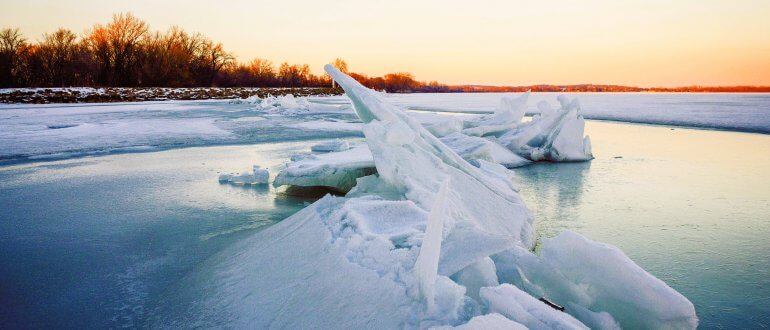
Lakes can be surprisingly noisy in winter. Ice fractures and cracks are constantly forming through these cold winter months, causing audible sounds ranging from a slight echoing “blooop” sound to a startling or explosive “bang!” Why exactly are our icy lakes so loud?
Ice isn’t always as solid as it looks
Although lake ice appears stable and solid, it is an ever-shifting material subject to ever-changing forces. Unlike nearly every other substance or material, the volume of water significantly expands as it freezes, increasing the given volume of water about 9% after freezing. The expansion can induce incredible amounts of pressure onto the ice. Think about how frozen water can cause metal pipes to bend and burst.

Expansion and pressure
Ice has a relatively high degree of flexibility to shift and distort during the freezing process (similar to how glacier ice will slowly “flow” down a mountain). When expansion pressure exceeds the ice’s capacity to bend and adjust, it will fracture and shift, creating vibrations and those ominous cracking sounds. Gradual ice movement and distortion put pressure on structures, making it necessary to remove seasonal piers and boat hoists for the winter. The immense pressure contorting the ice will also bend a pier along with it!
The temperature of the ice itself can also cause fissures and cracks, with dropping temperatures resulting in contraction and warming events leading to expansion. This is why we often hear the most ice cracking while it is rapidly forming, or as air temperatures quickly rise and fall during the morning and evening hours.

When ice cracks
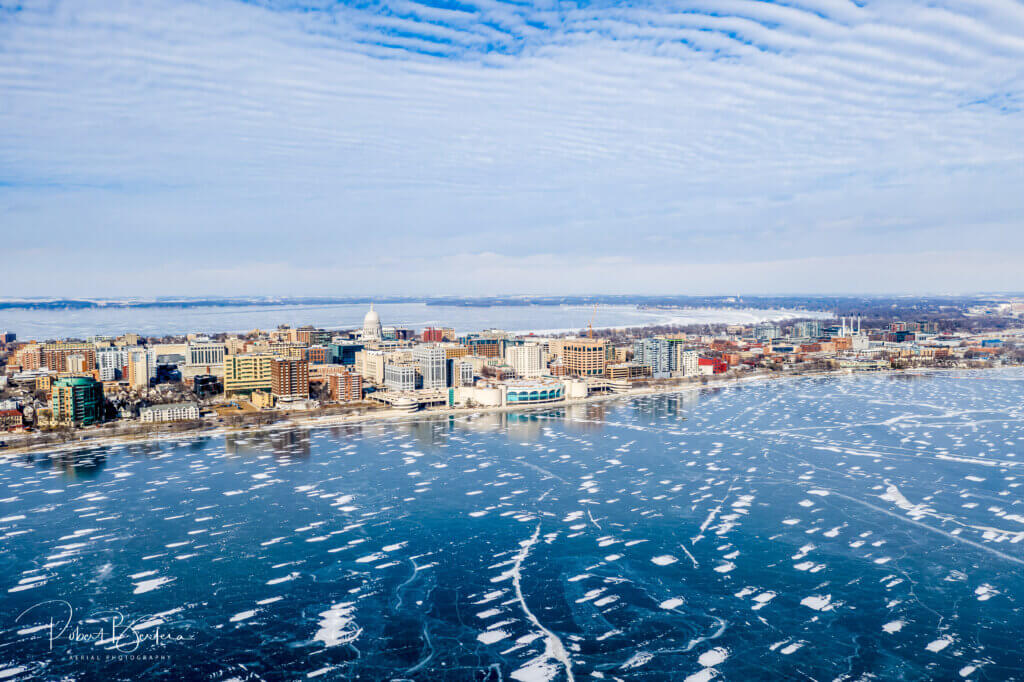
The Madison region may not be known for earthquakes, but its unique location between several large, frozen lakes can cause something perceivably similar – ice quakes! Severe winter cold snaps coinciding with a lack of insulating snow on top of the frozen lake surface can lead to rapid ice formation. The resulting pressure can become so great that small ice fissures are unable to dissipate the escalating pressure of the ice. This crescendoes to an explosive release of ice pressure strong enough to be felt by those on land (particularly by the Isthmus) and heard miles away.
Ice quakes
Hiroki Sone, an assistant professor in the Department of Geological Engineering at UW-Madison, explains that the same process that creates ice-expansion cracks also produces ice quakes, but on a much larger scale. Compared to tectonic quakes caused by shifting land masses, the actual mechanics and results of these ice quakes are relatively unresearched. Sone also notes that ice expansion likely causes the large ice rifts and ridges seen on the Yahara lakes, although researchers have not yet directly linked their formation to an ice quake.
Studying ice quakes on Greater Madison’s lakes
Professor Sone is working with undergraduate researcher Beth Dickinson to study the ice-quake phenomenon. Using open-source seismic data from Raspberry Shake, Dickinson was able to triangulate the approximate location of an ice quake event that occurred on January 22, 2025, on Lake Monona. Because of this area’s lack of significant tectonic forces, seismometers used to measure these forces are not as dense as they are in other parts of the country. More seismometers would allow for a better identification of ice quake locations and may lead to finding an association with the resulting ice fissures or rifts.

Ice freeze-thaw cycles
The ice booms and cracks we hear and feel are not necessarily dangerous. They are often signs the ice is adjusting to pressure forces during temperature-driven, freeze-thaw cycles. However, large ice expansion ridges sometimes result in areas of thin ice or open water near the crack. While out on the ice this winter, it’s best to practice ice safety awareness and avoid getting too close to ice ridges and areas of open water. To learn more about the science of lake and river ice, please visit the University of Minnesota-Duluth Sea Grant website.
(Article written by Mike Smale, Clean Lakes Alliance Watershed Programs Specialist)