BY KIM MEYER, AGRONOMIST, DANE COUNTY LAND & WATER RESOURCES DEPARTMENT
Exploring conservation methods
Farmers have limited opportunities — approximately 40 over their lifetime — to explore new conservation practices. This makes change inherently risky as they often must wait until the following year for another chance. This reality underscores the effectiveness of farmer-led initiatives, where farmers collaboratively share knowledge and experiences to achieve common objectives, such as enhancing soil health while safeguarding water quality and ensuring farm profitability. Farmers have firsthand insight into the challenges associated with adopting new conservation methods.
Join us in-person only for Clean Lakes 101 on Tuesday, November 18th, at The East Side Club from 4:00 – 5:00 p.m. Hear from Ho-Chunk elder Janice Rice as she shares teachings, stories, and values that highlight the deep connections between the Ho-Chunk people and the Teejop (Four Lakes) land and waters.
Register by entering your information in the box below
About this Talk
Many of the roads and pathways of the Teejop (Four Lakes) region are built upon the trails of the Ho-Chunk people. Before the first European settlers arrived, the beauty and bounty of the lands and waters were loved and respected by Indigenous people. Janice Rice, a Ho-Chunk elder, will share values, teachings, kinship, and relationships that frame a Ho-Chunk worldview. Join us as we hear tales and remembrances that evoke an enduring respect for the Teejop land and waters.
About our Speaker
Janice Rice, a Ho-Chunk tribal member, is an emerita University of Wisconsin (UW) academic librarian who received her education degree from UW–Milwaukee and her MLS advanced degree in Indian Librarianship from UW–Madison. She has been active in Teejop (Four Lakes) since the late 1970s. Since her college days, she has been an activist, environmentalist, and educator.
Janice has been an advocate for saving the Indian Mounds in Monona and has served on the campus committee that transformed the Tenney bike path into the Lakeshore Nature Preserve. In 1988, she assisted with the installation of the Tree of Peace and a marker near the UW Observatory and the effigy bird mound.
As a Clan Mother for Ho-Chunk Nation Social Services, she provides guidance for young Ho-Chunk women. She serves on the Teejop Community History Project and the Harry Whitehorse International Wood Sculpture Festival Board. On campus, she has advised UW–Madison’s cultural landscape tours and Teejop Waterscapes boat tours.
From 2022 to 2024, she served on the Lake Monona Waterfront Design Challenge Ad Hoc Committee for the City of Madison. In 2023, she was elected president of the first tribal library for the Ho-Chunk Nation and continues to be a voice for Ho-Chunk history, the waters, the environment, and the preservation of art and culture.
Event Details
This event will be held at The East Side Club (3735 Monona Dr, Madison, WI 53714). Doors open at 3:30 p.m. The program runs from 4 – 5 p.m. A Q/A session will follow the presentation as time allows. Complimentary event parking will be available at The East Side Club. Parking spots fill up quickly and may be limited depending on capacity.
Join us for this in-person or virtual hybrid edition of Clean Lakes 101 to learn about the existence and demise of glacial Lake Yahara. Register as an in-person attendee or to receive a Zoom link through your confirmation email and watch virtually.
Register by entering your information in the box below
About this Talk
Following the retreat of the last glaciers from Wisconsin a glacial lake formed along the retreating ice margin in the Madison area. Known as glacial Lake Yahara, this lake covered the footprint of the modern four lakes of Madison at a slightly higher lake level and persisted for several thousand years following local deglaciation.
In conjunction with research into a nearby, former glacial lake in Dodge and Jefferson counties, a series of sediment cores was collected from low-lying marshes in the Madison area. These targeted locations would have been inundated by glacial Lake Yahara but exposed as the lake level eventually fell. The cores provide chronologic and environmental data on the existence and demise of this lake.
About our Speaker
Eric Carson is a research geologist with the Wisconsin Geological and Natural History Survey (WGNHS) and professor at the University of Wisconsin-Madison; he is also currently serving as Interim Director and State Geologist for the WGNHS. He received his B.S. (Geology) from West Virginia University, and both his M.S. (Geology) and Ph.D. (double major, Geology and Geography) from the University of Wisconsin-Madison. He has 20 years’ experience in academia and research. His research at the WGNHS investigates the timing of the last glaciation in Wisconsin, processes associated with rivers and flooding, and how landscapes evolve over timescales ranging from thousands to tens of millions of years.
Event Details
This event will be held at The Edgewater hotel – grand ballroom level 5 (1001 Wisconsin Pl, Madison, WI 53703). Doors open at 7:30 a.m. The program runs from 8 – 9 a.m. A Q/A session will follow the presentation as time allows. Complimentary event parking will be available at The Edgewater parking ramp. Parking spots fill up quickly and may be limited depending on hotel capacity.
A Zoom link will be sent to all registrants in a confirmation email.
Join us for this in-person or virtual hybrid edition of Clean Lakes 101 on Wednesday, October 12, 2022. Register below as an in-person attendee or to receive a Zoom link through your confirmation email and watch virtually.
Register by entering your information in the box below
All Clean Lakes 101 events are free to Friends of Clean Lakes Alliance. Friends are individuals that support our lakes annually with a tax-deductible donation.
About this Talk
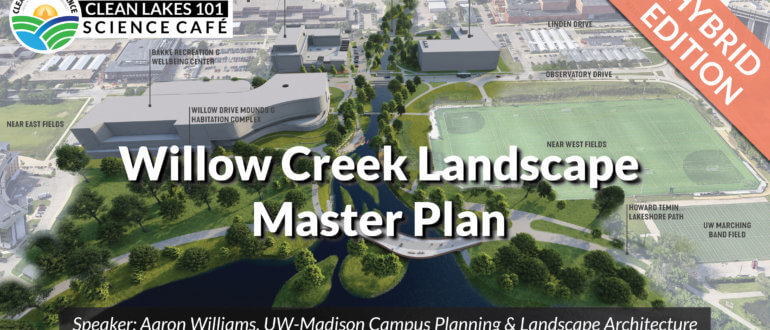
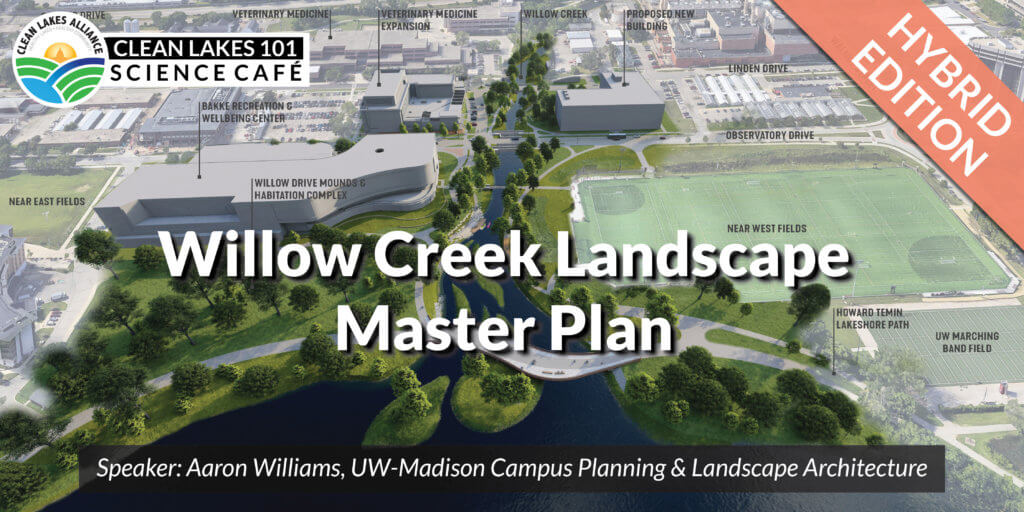
Following on the successful implementation of the City of Madison/UW/State partnership for an in-stream sediment settling channel and stream bank restoration, UW-Madison retained SmithGroup to carry out a landscape master plan to create the necessary planning and analysis documents to envision a restored Willow Creek corridor. This presentation will review the overall project objectives within the planning framework of environmental quality, green infrastructure practices, community placemaking, and land stewardship. With the increased student/faculty/staff population into the area planned with adjacent development, Willow Creek is envisioned to transcend simple stormwater conveyance into an integral component of the campus greenspace network that is set up to ensure management success and act as an amenity for the entire community.
About our Speaker
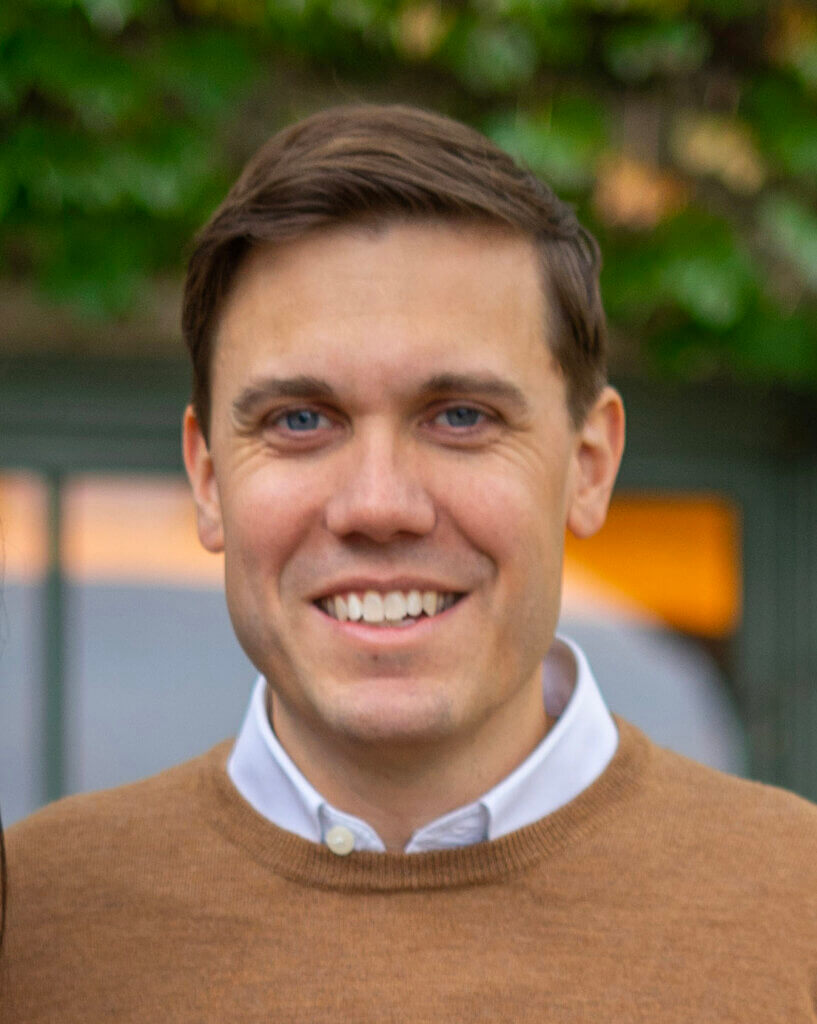
Aaron Williams, PLA, ASLA currently serves as the interim director of Campus Planning & Landscape Architecture, overseeing the development, interpretation, and implementation of the campus master plan on the spectacular 938-acre University of Wisconsin flagship campus. Additionally, he is involved in physical development area plans, land use studies, building massing studies, mobility planning, campus signage and wayfinding, as well as coordinating the municipal zoning approval process and being a liaison between adjacent neighborhoods through the Joint Campus Area Committee and UW-Madison Design Review Board. He is a UW-Madison alum and licensed landscape architect.
Event Details
This event will be held at The Edgewater hotel – Mendota Ballroom level 3 (1001 Wisconsin Pl, Madison, WI 53703). Doors open at 7:30 a.m. The program runs from 8 – 9 a.m. A Q/A session will follow the presentation as time allows. Complimentary event parking will be available at The Edgewater parking ramp. Parking spots fill up quickly and may be limited depending on hotel capacity.
A Zoom link will be sent to all registrants via your confirmation email.
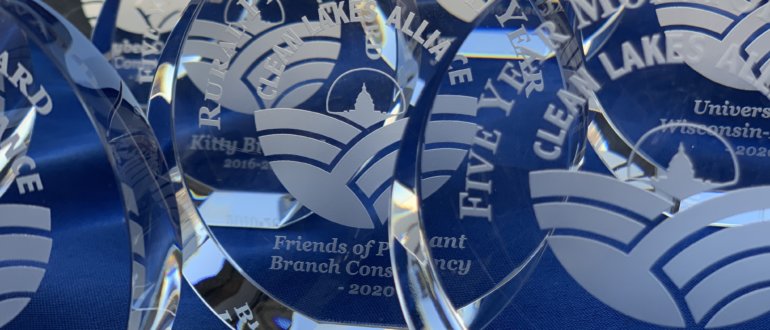
On January 13th, 2021, Clean Lakes Alliance honored groups and individuals at a special edition of Clean Lakes 101 Science Café. Clean Lakes 101: Awards, Accomplishments, & Ambitions, included the 2020 Community Awards presentation in which Clean Lakes Alliance recognized the accomplishments of individuals, volunteers, businesses, and other entities working to protect and improve our Yahara lakes.
A letter from University of Wisconsin-Madison about the Yahara CLEAN Compact
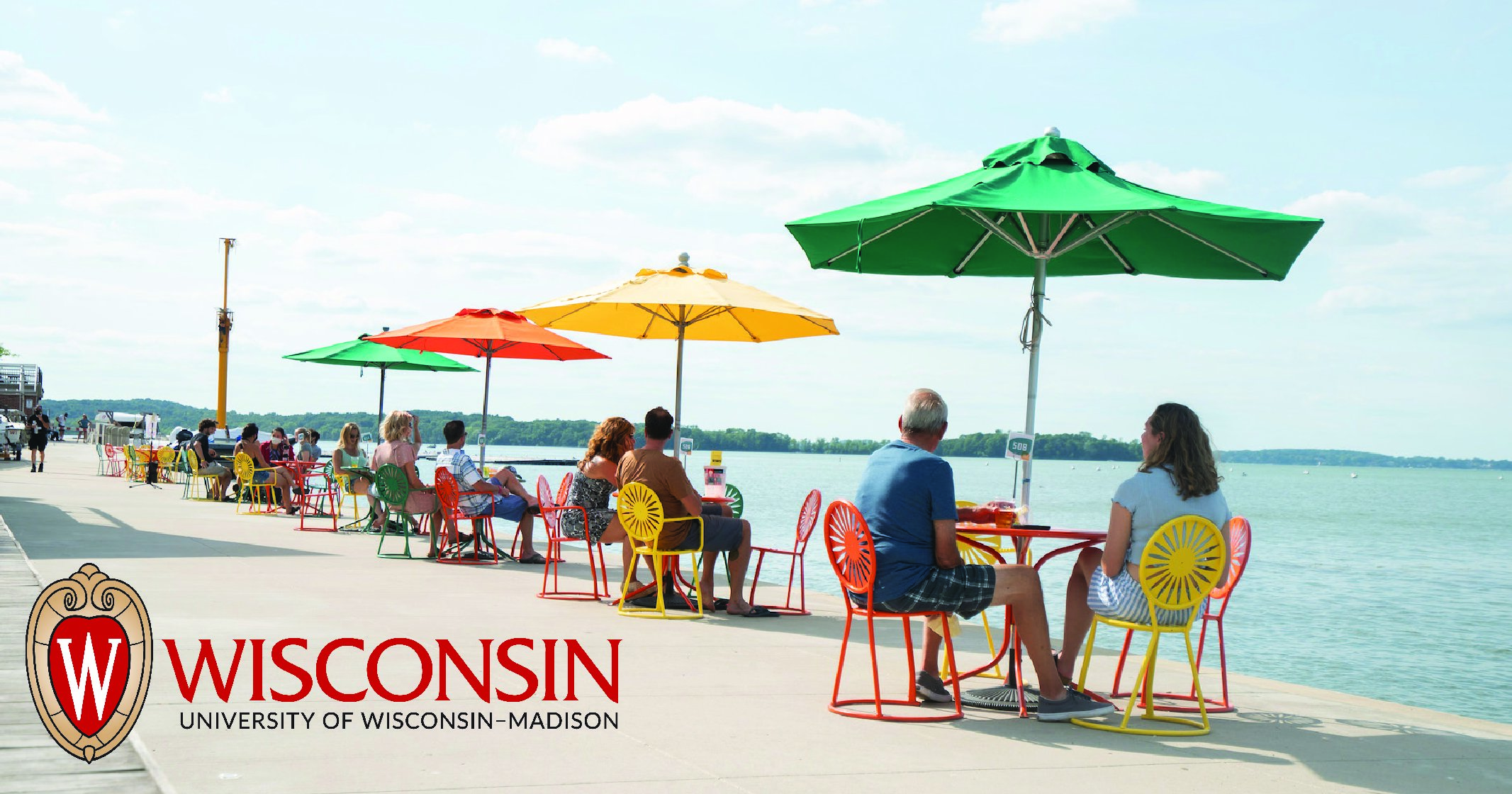
Like everything else this year, visiting the Memorial Union Terrace feels a little different. Yet as we sit apart, looking over Lake Mendota, it serves as a reminder that the physical distance between us is a sign of strength. We are reminded of what we can accomplish when we have the resolve to tackle a challenge, and Clean Lakes Alliance is evidence of that.
A shared vision for clean, safe, and accessible lakes
In August 2019, leaders from government, business, and nonprofit organizations came together with a shared vision. The vision included a future in which Greater Madison’s five Yahara lakes are clean, safe, and accessible for everyone. Together, the 19 partners and collaborators formed the Yahara CLEAN Compact and committed to sharing resources and working together to curb pollution and chart the best path forward to cleaner, healthier lakes.